
Januray 23rd, 2026 / San Dionisio, Oaxaca
The Zapotec: The Civilization That Lives in Every Drop of Oaxacan Mezcal
Before there was mezcal, there were the Zapotec.
To understand mezcal — truly understand it, beyond flavor profiles and production methods — you need to understand the civilization that shaped the land, the culture, and the sacred relationship with the agave plant that preceded the modern spirits industry by more than two thousand years.
Origins: The Cloud People
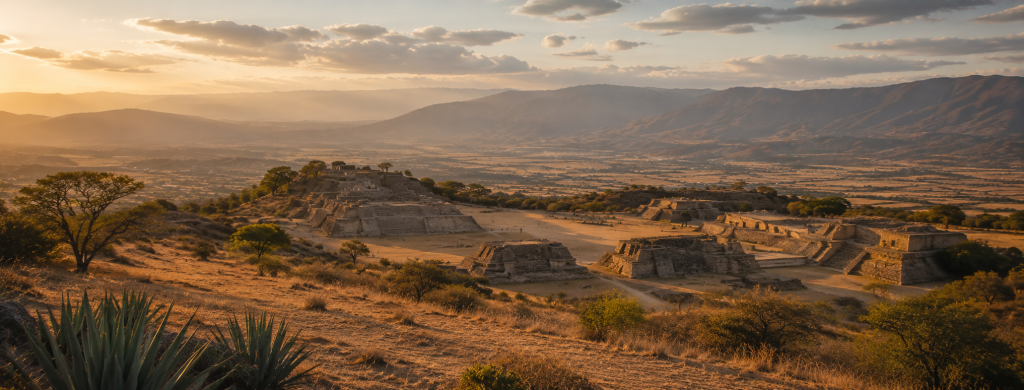
The Zapotec are one of the oldest continuous civilizations in the Americas. They settled in the Valley of Oaxaca in what is now southern Mexico as early as 700 BCE, and at the height of their power, between approximately 100 BCE and 700 CE, they built Monte Albán — one of the first true cities in the ancient Americas — on a mountain top above the valley, commanding a view of the surrounding mountains in all directions.
They called themselves Be’ena’a — the Cloud People. The name referred to the belief that they had descended from clouds, trees, and jaguars, and it reflected a worldview in which the natural world was not a backdrop to human life, but the very source of it.
Monte Albán at its peak housed tens of thousands of people and served as the political, religious, and cultural center of Zapotec civilization. Its pyramids, plazas, and astronomical observatories are still visible today, sitting above the modern city of Oaxaca like a reminder of what was here long before the Spanish arrived.
Language and Diversity
The Zapotec were never a single, monolithic group. They were — and remain — a collection of communities bound by common ancestry, culture, and a shared linguistic root, but differentiated by geography, tradition, and dialect.
Today, linguists recognize more than 60 distinct Zapotec languages and dialects spoken across Oaxaca. These are not accents or regional variations of a single language — they are genuinely distinct linguistic systems, many of which are mutually unintelligible. A Zapotec speaker from the Sierra of Oaxaca may not understand a Zapotec speaker from the Isthmus of Tehuantepec.
This diversity reflects the rugged topography of Oaxaca itself: a state of deep valleys, high mountain ranges, and isolated communities that developed their own traditions over centuries of relative separation.
Zapotec is a tonal language, meaning that the pitch at which a syllable is spoken changes its meaning — a feature it shares with Mandarin Chinese and many other languages in the world, but that makes it extraordinarily complex to learn for speakers of non-tonal languages. Many Zapotec communities have worked to document and revitalize their specific dialects, an effort that has taken on urgency as younger generations migrate to cities and Spanish becomes the dominant language of daily life.
Spiritual Life and the Sacred Agave
For the Zapotec, the agave plant — known in Nahuatl as metl, and in Spanish as maguey — was far more than a source of fermented drink. It was a sacred organism, tied to deities of rain, earth, and fertility.
The agave provided almost everything a community needed: its fibers were woven into clothing and rope; its spines served as needles and tools; its sap could be fermented into pulque, a mildly alcoholic drink consumed in ritual contexts; and its roasted heart provided food.
The ritual use of fermented agave drinks in Zapotec and other Mesoamerican cultures was deeply regulated. These were not recreational drinks in the modern sense — they were consumed in ceremonial contexts, by priests, elders, and participants in specific rites, as a means of communing with the divine. The Spanish missionaries who arrived in the sixteenth century were alarmed by what they saw as drunkenness but misunderstood the structured spiritual context in which these drinks were used.
After the Conquest: Survival and Transformation
The Spanish conquest of Oaxaca, which began in the early sixteenth century, brought devastation to the Zapotec world. Populations collapsed under disease, forced labor, and displacement. Sacred sites were built over with churches. The formal Zapotec writing system — one of the oldest in the Americas — was suppressed.
And yet the Zapotec survived. Their communities, their languages, their agricultural practices, and their relationship with the agave plant persisted through five centuries of pressure, adaptation, and resistance.
It was during the colonial period that mezcal as we know it began to take shape. The Spanish introduced copper pot stills, and the indigenous communities of Oaxaca — particularly in the regions of Miahuatlán, Tlacolula, and the Sierra of Oaxaca — adapted this technology to the roasted agave hearts they had been preparing for centuries. The result was mezcal: a distilled spirit born from the union of indigenous tradition and colonial technology, and claimed most fully by the communities that made it.
The Zapotec Today
There are approximately 800,000 Zapotec people in Mexico today, making them one of the largest indigenous groups in the country. The majority live in Oaxaca, with significant communities in Mexico City, and a notable diaspora in the United States — particularly in California, where agricultural labor migration brought many Oaxacans over the past several decades.
Zapotec communities have been at the center of some of Mexico’s most important indigenous rights movements, particularly around land rights, educational autonomy, and political self-determination. The concept of usos y costumbres — traditional community governance systems that operate outside the standard Mexican political party structure — is recognized in Oaxacan law, and many Zapotec communities govern themselves according to ancestral models of collective decision-making.
In the mezcal world, Zapotec communities are the living custodians of production knowledge that stretches back centuries. The maestros mezcaleros — the master distillers — who work in the Sierra Oaxaca, the Cañada, and the Valles Centrales are the direct descendants of the people who first roasted agave in the ground and watched the liquid drip from a still made from clay.
Why This Matters for Mezcal
Every bottle of authentic Oaxacan mezcal is, in some sense, an artifact of Zapotec civilization — a product that would not exist without the knowledge, the land stewardship, the linguistic diversity, and the spiritual relationship with the agave that the Zapotec developed and preserved over millennia.
This is not a romantic abstraction. It is a fact with real economic and ethical implications. The growth of the international mezcal market has brought money into Oaxaca — and it has not always reached the communities that hold the knowledge. The challenge for brands, importers, and consumers alike is to ask hard questions about who benefits from the mezcal in the glass, and to support the models that return value to the people and communities that make it possible.
Understanding the Zapotec is not optional context for drinking mezcal. It is the beginning of drinking it honestly.